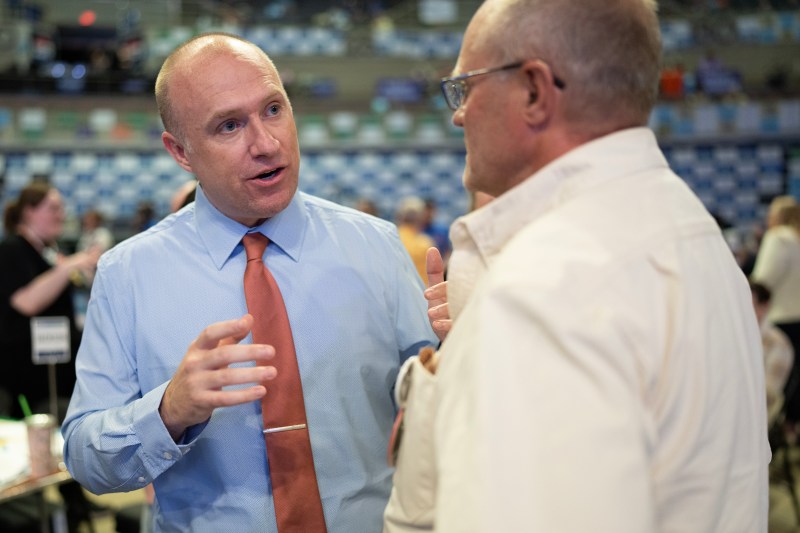
Jake Johnson, the DFL-endorsed candidate for Minnesota’s 1st congressional district, says he’s trying to do what incumbent Brad Finstad isn’t: show up. A lifelong southern Minnesotan, Johnson is campaigning to flip the district’s seat blue, prioritizing affordability, tackling corruption, and investing in small towns.
“I’m a citizen who has been concerned throughout this campaign that the voices of people here in southern Minnesota, and probably across the state, are not being heard enough. We need a government that is responsive to its people. That means showing up, that means listening, and that means speaking with a clear voice for the working people of this district who continue to be squeezed,” Johnson says.
Johnson grew up in Stewartville, just south of Rochester, as part of a family that relied on federal resources like SNAP and Medicaid to get by–the very things that Republicans in Congress made historic cuts to in 2025 by passing the One Big Beautiful Bill. He’s also been a teacher for 20 years. Using his personal experience, Johnson says they are “fighting for the American dream, for the next generation of southern Minnesotans.”
On the issues
While improving the economy is at the center of Finstad’s reelection campaign and his website touts the passage of the Working Families Tax Cut Act, Johnson says his opponent “continues to support policies that are not fiscally responsible.” Finstad voted for the OBBB–which passed the US House by one Republican vote and has been forecast by the Congressional Budget Office to raise the national debt by $3.4 trillion from now to 2034. Finstad’s vote was despite 14 Republicans in the Minnesota Legislature warning him not to back the plan, including six GOP lawmakers from his district. He also has voted in support of President Donald Trump’s tariffs, as well as Trump’s war on Iran.
Southern Minnesota is largely made up of farmers and families. Currently, the state just saw the largest amount of farm bankruptcies in the country. Johnson says he regularly hears from residents that “input costs are too high, largely because of tariffs…and also export markets have been eviscerated and slammed by Finstad’s policies.” And these aren’t the only issues farmers are facing. Johnson says, “We need to get our spending under control…a tax policy that is fair…and when we look at what that looks like in Congress, it is being serious about the fact that we have a national debt crisis in this country.”
Johnson told Courier Minnesota he will help remedy this debt by not voting for a debt ceiling increase “until we have a balanced budget” and teased that his team will be releasing more information on the issue soon. He added that members of both parties need to be held accountable for “the huge tax breaks handed over to billionaires and large corporations, all the while driving up our debt.”
Talking education
With his background in teaching, Johnson has also outstretched a hand to the youth in his community. He has former students serving on his campaign team, he says as a way to get young people engaged in politics.
Johnson says a focus on public education is another top priority issue for him, as it’s “the heartbeat of so many small towns across southern Minnesota.” “People go to the football games on Friday nights. They go to the plays. They watch the speech team. They listen to the band…But that promise of public education that is high quality for all students is under threat.”
He says one of the biggest threats facing public education today is a lack of funding from the federal government “unwilling or unable to pay their bills.” Special education funding in particular, he noted, is coming up short.
When the Individuals with Disabilities Education Act was first implemented, the federal government would pay 40% of the bill. Now, they pay roughly 12%. Johnson says, “That means of the dollars that local districts are supposed to be getting from the federal government, two out of three are missing…And so that burden for the school districts continues to fall disproportionately on local taxpayers.”
His town hall promise
In representing southern Minnesota, Johnson says Finstad is largely M.I.A. Finstad has never held a public town hall, only holding telephone conferences, which are usually given with little warning, if any. Johnson says he hears people across the district asking, “Why won’t my congressman meet with me?” “That should not be a luxury,” he says, “And then he actually went into the media and said, and then doubled down on the fact that people, his constituents, us, who are asking for town hall meetings, are a pitchfork-wielding mob, uh, throwing hissy fits.”
Just recently, Johnson announced his plan to address the problem: 21 town hall meetings, one in each county in southern Minnesota, before Election Day. He says he’s “excited for Republicans, Independents, Democrats, apolitical folks to come out to our town hall, share their concerns, [and] share their solutions.” Johnson added that, if elected, he will host a town hall in each county every term.
While looking forward to those town halls and reflecting on his campaign, Johnson commended the people of Minnesota for being “incredibly caring, hardworking people” and added that “we need a government as good as its people.” He says the November midterm elections is what this is all about: “taking back the government for the people and by the people, and that’s exactly what we’re trying to do.”