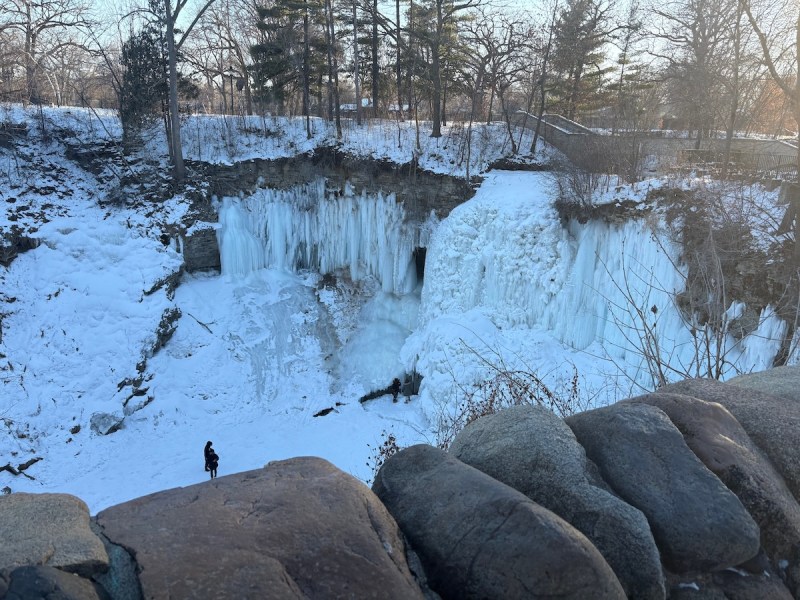
Minnehaha Falls, located in Minnehaha Park, is a natural waterfall in an urban setting. Overlooking the Mississippi River, Minnehaha Park sits on 193 acres. Along with the 53-foot waterfall, the park features limestone bluffs and river overlooks. All types of trees are within its limits, including oak, elm, silver maple, basswood, hackberry and cottonwood trees.
Why it matters
Just over a century after the United States became an independent nation, and three decades after Minnesota became a state, Minnehaha Falls was purchased for $100,000 by the city of Minneapolis to become the centerpiece of a new state park. Settlers referred to Minnehaha Falls as “Little Falls” to distinguish it from the larger cascade on the Mississippi River.
What to see today
Despite its centralized location within the Twin Cities, the 167-acre spot encompassing the falls is a bigger park than many initially realize. Once you descend the steps into the gorge near the falls, there are hiking trails that lead to a swimming hole and even a sandy beach.
Along with the falls, visit botanical gardens, monuments and historical sites, or enjoy a picnic. For children, there is also a playground and wading pool. There is also a disc golf course and volleyball court.
Get additional exercise in by biking or walking on the paved path that runs along the perimeter of the park. With the upper Mississippi River visible just east of the park, a myriad of photo opportunities are available as well.
America 250
Located only five miles from downtown Minneapolis, Minnehaha Falls is a 53-foot waterfall situated in Minnehaha Creek, an area that eventually meets the Mississippi River. Its beauty was captured by Henry Wadsworth Longfellow’s 1855 epic poem “The Song of Hiawatha,” which transformed the falls into an icon, although the New England poet never visited the site.
Officially named Minnehaha Regional Park, the falls lie within the Mississippi National River and Recreation Area, a 72-mile, 54,000-acre protected corridor along the Mighty Mississippi and through both Minneapolis–St. Paul. The park was designed by renowned 19th-century landscape architect Horace Cleveland in 1883 and became one of the first state parks in the United States. Only New York created a state park earlier.
Cleveland sought to leave the falls and the creek below the park in their natural state. The Minneapolis Park Board built a pavilion in 1892 on land beside the falls and through the years introduced various attractions, including a zoo from 1892 until 1907. In 1896, the first permanent settler’s home in Minneapolis, built in 1849 by John Stevens, was moved to Minnehaha Park and a statue of him was placed nearby in 1935. A Victorian train depot — only 22 feet by 20 — was constructed in 1875 within the park.
“We’ve developed Minnehaha Regional Park to serve as one of the premier gathering spaces for communities throughout Minneapolis and the surrounding area,” Minneapolis Park and Recreation Board Superintendent Al Bangoura told the Times. “People picnic under an ancient canopy of mature oak trees, kids play on a fully accessible playground and splash pad, musicians perform at a gorgeous bandshell, and gardeners cultivate spectacular gardens. The park contains layers of history, literally through the park’s unique geology, historic structures integral to the founding of Minneapolis and sacred Indigenous sites dating back to time immemorial.”
Listed on the National Register of Historic Places in 1969, Minnehaha Park draws 2.3 million annual visitors from across the world, making it the second-most visited park in the Twin Cities area, following Como Park in St. Paul.
Plan your visit
- Best time: All seasons
- Hours/Admission: 6 a.m. – 10 p.m. Admission is free.
- Getting there: Personal vehicle, bus or light rail
- Learn more here
USA 250 Most Treasured Views is a USA TODAY Network project exploring places across America with historical and cultural significance, created in celebration of the USA 250 initiative marking the nation’s 250th birthday.