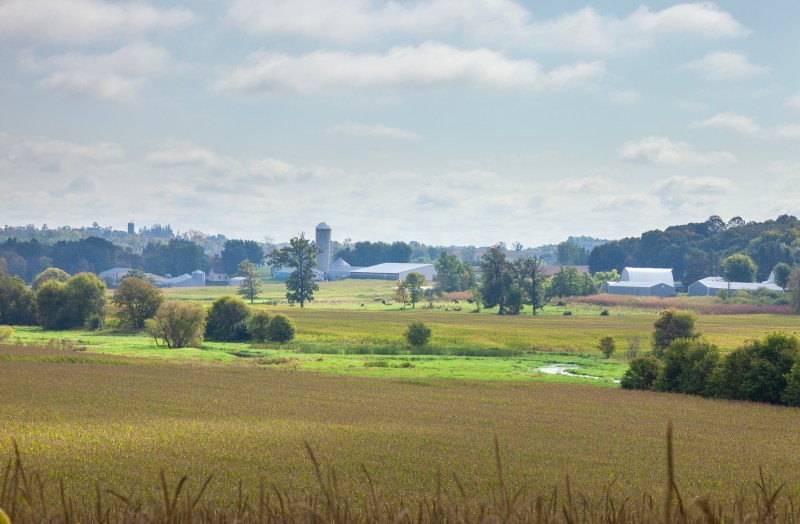
The rising price of both gas and fertilizer, as well as federal tariffs, are just a few of the factors putting a major strain on farmers nationwide. In Minnesota, these issues are leading to bankruptcies and frustration for dairy, corn, and soybean farmers across the state.
Planting their crops now, farmers don’t know if the harvest will bring in enough money to continue operations beyond this year—and that’s a major problem for both the farmers themselves and the state’s economy.
Meg Moynihan, a senior advisor at the Minnesota Department of Agriculture, says farmers in financial trouble have few options right now. “We’re hearing from some farmers who say, ‘I cannot see my way clear between land rent and the input costs, and what I’m projecting I’ll be getting for my crops. So I’m going to park my equipment and rent it out for the year,’ she says. “That goes against everything in the fiber of the soul of a farmer when you are just committed to producing these crops for people.”
The Iran war’s closure of the Strait of Hormuz
Moynihan says there is a direct tie between the closure of the Strait of Hormuz and the cost of multiple farming necessities shooting up.
Firstly, the most impacted necessity is oil and gas. Since President Donald Trump decided to go to war with Iran at the end of February, oil prices have increased at least 55%. In farming, oil is used to lubricate machinery, and to create the plastic farmers will wrap their produce in.
Since oil is used to make gas, gas prices have skyrocketed as well, with the current average in Minnesota at $4.12 a gallon of regular fuel. For farmers, most of the machinery they use—from trucks and tractors to Bobcats—require diesel fuel, which currently averages $5.15 a gallon. Because tractor gas reservoirs are quite large, typically holding 10-30 gallons each, farmers are feeling the pinch.
Much fertilizer is also petroleum-based, making it unaffordable for the year. The American Farm Bureau Association reports that 70% of farmers can’t afford the amount of fertilizer they need for the year. Moynihan explains that the majority of the fertilizer Minnesotans use is nitrogen fertilizer, which has increased in price by more than $20 per acre since the war began. When the average Minnesota farmer is farming 388 acres each year, that adds up quickly.
Due to the higher prices, Moynihan says some farmers are “applying less than they ordinarily would, and the dominos on that are that the crops will not produce as much,” which will also cut into their margins for the year.
Other countries are turned off by tariffs
Tariffs are also hurting farmers, leaving them without enough money from their produce to cover their yearly costs. Currently, the tariff–or tax–on imported goods is generally 10%.
Christina Connelly, the international trade supervisor at the Minnesota Department of Agriculture, says this round of tariffs, compared to those passed during Trump’s first term as president, are having a much larger impact on farmers. “It wasn’t just steel and aluminum and a couple of other things,” she says, “It was across the board more globally…In the last six months, we’ve seen lots of changes, but none that has been predictable or consistent. It’s just been constant chaos and farmers have been caught in the crossfire.”
When oil and gas prices rise, everything that requires transportation and shipping will see an increase too, due to the amount of gas used to send it elsewhere. Add in the import tariffs, and the cost of seeds, chemicals, and machinery parts have all increased.
Minnesota’s biggest exports are soybeans and corn. Because of the high tariffs, many countries have imposed retaliatory tariffs, like China, Canada, and the European Union (EU).
China effectively boycotted buying soybeans from the US in 2025. While a deal was met, farmers say the damage is done. Connelly says China is the state’s biggest concern “because something like a third of our soybeans end up there.” If that market is lost, so are many farmers’ livelihoods. She also points to Mexico and Canada as close allies and friends, but “the security of the North American Free Trade Agreement (NAFTA) and now the United States-Mexico-Canada Agreement (USMCA) was kind of blown up in different ways, and is still somewhat uncertain.” NAFTA was terminated in 2020, and the USMCA is being reviewed.
Farmers need certainty
The compounded struggles leave farmers with one feeling: uncertainty. In the last two years alone, Minnesota has lost 1,300 farms. These losses are partially due to farmers having trouble paying for their work ahead of time. Moynihan is also a dairy farmer in a farming neighborhood. She says she’s “heard from people that are having trouble getting the loans they need” to stay in business.
Moynihan explains that in the spring, farmers usually take out an operation loan, so they can afford to buy the supplies they need to plant their crops, then they pay that loan back once harvest is done in the fall. But, she says that banks are “leery” about lending money this year. “Unless you have something that you can sell to generate that money, or you have family that will lend you money, it’s very scary for them. We have farm advocates who have worked with farmers who have unfortunately put those costs on their credit cards, and with interest rates so high, that’s really dangerous,” Moynihan says.
The ability to shift to a more prosperous crop, to possibly make up losses, presents another financial burden that comes with significant risk. Moynihan says the investments farmers make into the technology and machinery they have to grow their crops “is enormous.” The machinery cost for corn and soybeans is estimated at anywhere between $120-$180 per acre. Equipment also depreciates over time with costly fixes and specialty parts needed for regular maintenance. Moynihan also notes that farmers are skilled in the crops they plant, but not necessarily those that they typically haven’t. “It’s not easy to say, ‘Why don’t we do something else?’ And if you’re farming a thousand acres of corn and soybeans, trying to figure out, ‘Are we going to try a whole new crop just in the blink of an eye?’ That’s a tall order.”
“Farmers need certainty,” Connelly adds, “and even the sort-of bailout package that’s on the table is more of a band-aid and doesn’t really fix the problem.”
Connelly says the Farm Bill, which passed the US House on April 30 and is heading to the Senate, isn’t meeting farmers’ needs. Critics say it fails for a few reasons. The legislation doesn’t address the deep cuts to SNAP made in the One Big Beautiful Bill, or food inflation, it gives no help to family farms, it cuts agriculture conservation funding, it weakens pesticide regulations, and it threatens animal welfare laws.
Minnesota farmers’ hopes of staying in business are further diminished when these rising costs are passed down to the consumer. Because oil, gas, fertilizer, seed, and so many other resources are going up in price, farmers have to charge more for their produce. But many Minnesotans already couldn’t pay the previous price. One in five Minnesotans are food insecure, and rely on emergency food systems like Second Harvest Heartland and other food banks to feed their families. So, farmers also face a decrease in sales, as many can’t afford it.
What can farmers and Minnesotans do?
Farmers need federal certainty, which trickles down into how other countries that Minnesota exports to feel about continuing business with our state. But, they have to continue to plant, plan, harvest, and get ready for the next year. “I think farmers have to be cautious right now, but also can’t do nothing, right?” Connelly says.
Moynihan agrees, and directs farmers to call the Minnesota Farm and Rural Helpline, which hosts two, full-time mental health providers for agriculture workers, 24/7. The line is available over phone, Zoom, and even in-person visits to the farm, offering individual, marriage, and relationship counseling. “They’re getting tons of calls,” she says, “I think what’s happening is really hard on family relationships.” The MDA is also working on a Farm Suicide Prevention Campaign, as the rate of farmer suicides is about 3.5 times higher than the average population.
“Farming, I don’t want to say it’s a lifestyle, it is more in your blood than it is a job. And to be in such precarious times, and think, ‘My ancestors got through the first world war and the second and the depression. I inherited all the work they did. And what if I can’t keep the farm going?’ That’s terrifying,” Moynihan says.
The MDA’s Farm Advocate Program also offers one-on-one help for farmers facing crises due to natural disasters or financial issues. Farm Advocates are available throughout the state.
For Minnesotans wondering what they can do, Moynihan says compassion is important. She encourages people to speak to their elected representatives and let them know your feelings about agriculture and the farmers who help feed our state. Buying directly from local farms, advocating for sustainable farming policies, and getting involved in local farming advocacy groups are other ways to make a difference.