Minnesotans are being priced out of a good quality of life. Whether it’s childcare, housing, or healthcare costs, many Minnesotans can’t afford the basic necessities.
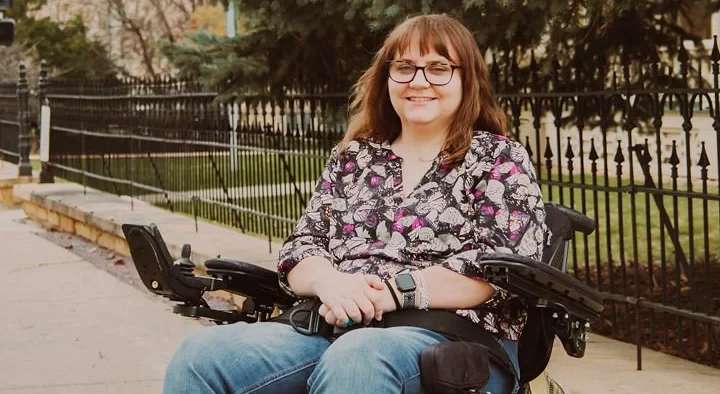
Leah Hanson, a social worker and individual with disabilities who lives in North Mankato, is intimately familiar with these problems, and hears the same from her clients every day. “I see firsthand a lack of investment in their wellbeing, and it worsens our community as a whole. It doesn’t just make life harder for the people I work with, it makes our community less strong and less resilient.”
This November, she’s running as the DFL-endorsed candidate for House District 18A, which covers St. Peter, Kasota, North Mankato, and parts of Mankato, to fight for policies that make life for Minnesotans affordable. And most importantly for her, that means fighting for a public healthcare option for Minnesotans.
Her public option push
As a social worker, Hanson says our current healthcare system prevents many Minnesotans from accessing the services they need, especially for those living in rural communities. While the state offers MNsure, this is for public and private healthcare insurance plans. Hanson says a public option would be the gold standard, and the state could achieve it by offering MinnesotaCare to everyone.
Currently, MinnesotaCare is offered to low-income residents who can’t afford Medicaid, those who can’t get health insurance through their employment, and some residents with disabilities. As a Minnesotan with a disability, Hanson has had MinnesotaCare for 14 years. “It provides me with really good healthcare, I think better healthcare than I had before, which was private insurance that I got through my parents,” she said.
There is an active legislative proposal that would expand MinnesotaCare eligibility, offering a public option to all Minnesotans. The bill was introduced in the state House and Senate in 2025, but has not gone anywhere.
If the state isn’t ready for a public option like this, Hanson says there’s more Minnesota can do to improve its healthcare offerings. This includes cutting managed care organizations out of the current MinnesotaCare so “we don’t corporations making a profit off of our healthcare systems,” investing money in having clinics stay open in rural areas, and ensuring reimbursement rates across all health insurance options are actually coming through to the state’s hospitals and clinics.
Creating a fifth tax tier
When it comes to reimbursements, Hanson points out that Minnesota’s Medicaid reimbursement rate “is abysmal.” This is on top of the federal government’s overreach for the past several months, like the recent $200 million deferred over “fraud concerns,” and the $243 million in payments withheld earlier this year. “It’s criminal,” Hanson said, “and no one in Washington is stopping them. I think as a state we need to figure out how to make up that shortfall if the federal government is going to continue and mess around with our Medicaid dollars.”
While the state legislature can’t set insurance reimbursement rates, Hanson believes the state can set a budget to help pay for these gaps, and that means increasing revenue. She says the state needs to look at who can afford to pay more toward the state’s bottom line and that’s the wealthiest of Minnesotans.
To Hanson, this looks like creating a new tax bracket for the highest-earning residents in the state. “I think that there’s class issues at play here, and I think the vast majority of people want a fairer tax system,” she said. In this year’s legislative session, a bill was introduced that would create a tax tier with a rate of 10.85% for Minnesotans who make an excess of $1 million as a married couple and $600,000 for individuals. This is compared to the other state tax brackets, which–from lowest to highest earners–have rates of 5.35%, 6.8%, 7.85%, and 9.85%.
Hanson believes if this tax tier were implemented and loopholes for corporations–like how tech companies are given tax incentives to build in Minnesota without necessarily having to give back to the economy–were closed, revenue could be increased without relying on the Minnesotans struggling the most.
Increased housing, childcare options
While healthcare and income tax disparities are statewide issues, Hanson says her district faces specific challenges with housing and childcare accessibility.
She says the Greater Mankato area specifically does not have enough housing volume for the population, particularly middle and lower-income families. The Mankato Housing Study says the city itself needs around 6,515 new housing units in the next decade.
Mankato is also the home to the biggest university in the state. Hanson says this “drives up housing costs by putting a strain on the rental market which makes it more difficult for families to find homes that are suitable for them to rent as well.” She says the district’s housing volume needs to increase, and single family homes need to be bought by actual families, “not purchased by private equity or corporation, then flipped and rented out or flipped and resold at dramatically increased prices.”
Going hand and hand with those who most desperately need housing, Hanson says there are “multiple entry points” to increase the volume of spots in childcare centers. She says this includes putting state money into childcare systems and making it easier for workers in the industry to unionize. Hanson also believes that regular statewide minimum wage increase for childcare workers is essential, as they “historically are grossly underpaid and undervalued.”
18A’s finicky voting history
18A is one of the “swingiest of swing districts” in the state, regularly flip flopping from red to blue over the last four elections. Hanson says it’s been quite expensive too, “as both parties are putting money into it, as well as a lot of independent expenditures.” It’s clear that the district is a muddied purple, which leaves the race a difficult one to forecast.
In fact, Hanson’s opponent, Republican incumbent Erica Schwartz, only won in 2024 with 52% support from voters. She’s campaigning on improving public education, “alleviating tax and financial burdens,” and providing law enforcement with more resources.
With a deadlocked House this year, Minnesota Democrats need multiple wins to control the House. Hanson says the GOP, including Schwartz, has focused on keeping that stopping power, rather than creating solutions for Minnesotans. “And that’s part of what encouraged me to run, is that I think we need a better voice.”
Hanson says she believes in her district values connection and community, something she’s building with her ideas for the state House. While the issues at hand come with vastly different solutions, she says it’s the willingness to represent the district’s opinions, not just the representative’s, that matters most. “We need transparency, accountability, and responsiveness in our elected leaders. We need leaders who are willing to talk to their constituents and have difficult conversations, and I’m willing to do that.”