Just four years after the Supreme Court overturned Roe v. Wade, one in three women in America now live in a state with an abortion ban. Because of this, experts and surveys alike say medical residents training to work in obstetrics and gynecology (OB-GYN) in states with bans aren’t learning the skills necessary to treat miscarriages, ectopic pregnancies, and abortions, and are forced to travel out-of-state if they want the training.
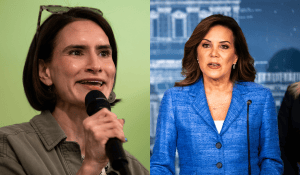
To get these students the training, US Rep. Kelly Morrison of Minnesota’s 3rd Congressional District–who calls herself the only pro-choice OB-GYN in Congress–is introducing the Safeguarding Access to Full-Spectrum Education (SAFE) Training for OB-GYNs Act. The bill would provide funding for medical programs that take on OB-GYN students from out-of-state, and pay for residents’ travel expenses.
“We have an OB-GYN shortage in our country, and it’s only gonna get worse,” Rep. Morrison said at a Thursday press conference “And the abortion bans that have popped up across the country since the Dobbs decision have led to inferior, frankly, training for OB-GYNs in states that have bans.”
A local clinic’s perspective
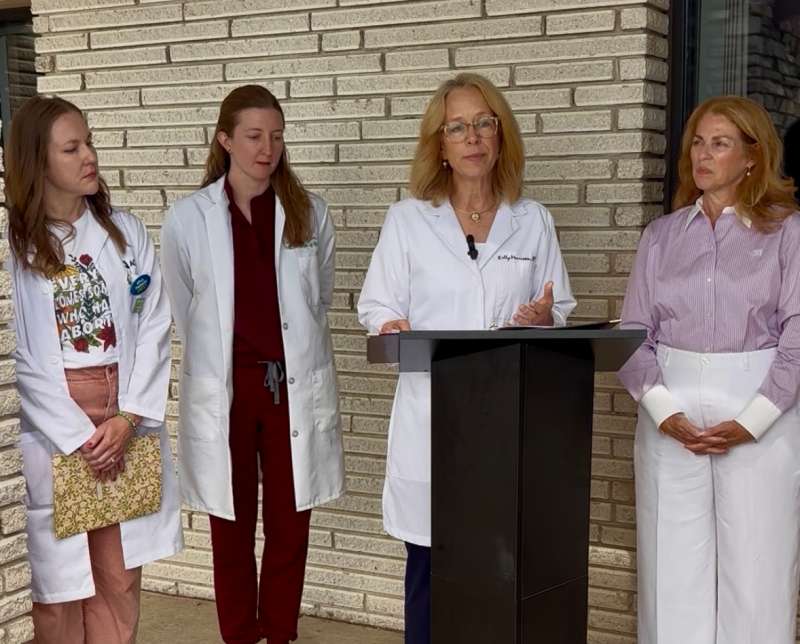
Rep. Morrison introduced the bill Thursday outside Whole Woman’s Health in Bloomington, Minnesota, a “privately owned, feminist healthcare company committed to providing fabulous abortion care for all who need it.” The clinic says about 25% of their patients come from out-of-state to get the care they need, because they can’t get it in their own state. Three local OB-GYNs gave their reasons why they support Morrison’s bill, and how their clinic has seen the increase in need.
Dr. Carrie Terrell serves on the Whole Woman’s Health Alliance board, which oversees all the clinics the system owns across the country. She said they’ve “committed to train those who completed their official program, but it lacked contraception or abortion training.” Terrell added that while there have been advances in simulations and AI patients, trainees need to be in front of real patients at some point. Residents are doctors that have a degree, but are getting more training in a specialized field, which requires building clinical skills and experience which is best achieved through work with real patients.
Dr. Courtney Kerestes, who also works at Whole Woman’s Health, said she used to work in Ohio, a state that implemented a six-week abortion ban almost immediately after the Dobbs v. Jackson decision was overturned. She shared that she had been seeing patients that morning at Planned Parenthood, “ and by 5 p.m., everything I had done that day would have been illegal.”
Kerestes said the clinic tried to build an out-of-state rotation for residents who were about to enter their family planning training, but “ there were numerous logistical challenges, including how to pay for them to travel there and live in a different state away from their home for a month at a time, in addition to all of the relationship building it took with other institutions to establish a program like that.”
Dr. Erin Stevens, a Twin Cities OB-GYN, pointed to the fact that many states with abortion bans dole out severe punishments, such as fines, loss of licensure, and prison time for up to a lifetime sentence. Because of this, applications for medical school and residency in multiple specialities have decreased dramatically. Stevens says, “ Medical professionals do not want to train under circumstances in which they cannot even learn and have to fear practicing the standard of care,” Stevens shared. “They want education in the right way to do the best for their patients in a safe setting. Ultimately, that’s what we should all want for these trainees.”
Abortion is healthcare, and everyone needs access
The American College of Obstetrics and Gynecology has deemed that abortion is essential healthcare.. And Rep. Morrison says this healthcare isn’t a partisan issue. She said that everyone regardless of their political party or religious background needs access to abortion care. The latest surveys from Pew Research Center also revealed that about 60% of Americans support legal abortion.
“I just would appeal to my colleagues across the aisle to think about the humanity of the individual people who need access to healthcare. I think it’s our elected officials who actually don’t reflect the will of the people in a lot of those red states,” Morrison said. Regardless of how you feel about abortion care, Rep. Morrison argued that it’s “part of comprehensive reproductive healthcare, and banned states are harming our ability to train OB-GYNs.”
Rep. Morrison admitted that it’s “very unlikely President Trump would sign the bill into law,” and that she may have to wait until another president— “a president who has a better grasp about reproductive health care and understands the urgency of this issue,” she said—is in office before the bill were to pass. Still, she said she would continue talking to Republicans about advancing the legislation, and she encourages constituents to contact members of Congress to make it happen.