St. Paul residents have some feedback for how city and county officials handled the federal Immigration and Customs Enforcement (ICE)’s Operation Metro Surge (OMS) in their city, and they shared it on Tuesday evening.
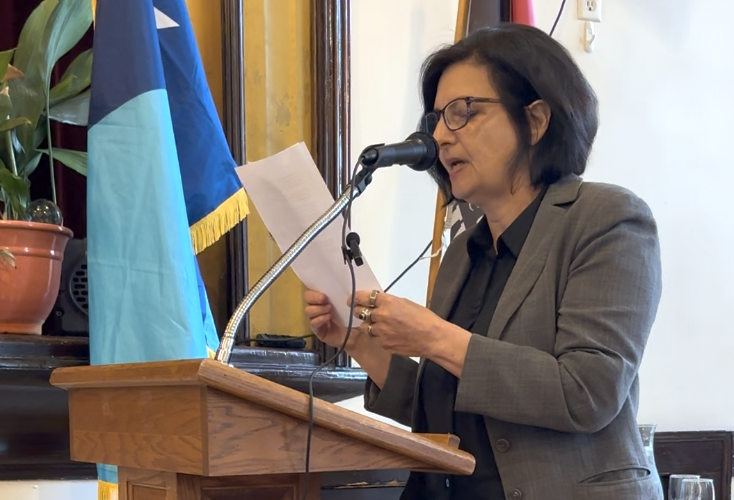
W7 Gardeners of Resistance, a chapter of Indivisible Twin Cities that began as a St. Paul gardening group, hosted “We are in this Together” at C.S.P.S Hall, a historical meeting house fitting for a town hall on accountability. The goals of the night were to provide feedback on how OMS went down in the city, to question how things will change the next time ICE is in Minnesota, to understand the scope of authority that police officers have when it comes to policing ICE, and to explore how to keep this year’s midterm elections safe.
Emotions ran high as speakers gave their testimony directly to the leaders in attendance at the event, who included Mayor Kaohly Her, Police Chief Axel Henry, and Assistant County Attorney Hao Nguyen.
John Benda, a former St. Paul math teacher who now serves on the board of Interfaith Coalition on Immigration (ICOM) relayed his experience seeing St. Paul police officers help federal agents in an immigration raid. He says he stood at City Hall in February 2025, watching leaders state that city employees “will not be deputized.” But Benda was present at the Rose Avenue ICE raid in November, where he says “St. Paul police appeared to be commandeered into service of ICE.”
“St. Paul police formed a perimeter around the home and shot and sprayed chemical irritants at us peaceful pro-protesters, despite our so-called separation policy. St. Paul police were masked, and most did not show their names that day. I’ve waited to hear a public apology for the actions of the St. Paul police that day, and an acknowledgement that some lessons were learned and things will be handled differently in the future,” Benda said.
Police Chief Henry said his department is going to “try to do both” when it comes to following state and federal directives “to try and lower the chance of anything happening.” When those remarks were met with boos, he acknowledged it’s a fair criticism that “you can’t do both.”
Henry continued, saying, “One of the things I think we did well, but not strong and good enough, was communication behind the scenes. And I think you could see the difference in outcomes between Minneapolis and St. Paul.” When looking back on the Rose Avenue raid, he says next time, he would “make a bigger stink” and convince officers to leave the area, as he said he did with the Bro-Tex raid.
Assistant County Attorney Ngyuen added that the city’s police department always has the authority to jump in when ICE is conducting illegal activity. He said that these were unprecedented times, as federal and local officials usually work together and share information.
“The authority that local law enforcement has is what they always have had,” Ngyuen explained. “ So if a police officer arrives to a call where a citizen is reporting a crime, the officer has the authority to ask that person who they are. Has the authority to ask for their identification and has the authority to investigate. If an officer sees an armed masked person beating someone bloody and all of this, that officer has the right and authority to intervene and save a life and to interject.”
Thalia Drori Ramirez, a clinical therapist at Relate Counseling Center and a downtown St. Paul resident, spoke of how her family “is still suffering from the invasion,” even though she and her family are not undocumented. She spoke directly to Mayor Her directly while addressing her, saying she had run into Her at the Centromex grocery store amidst the height of OMS.
“I reported to you that St. Paul police are allowing ICE to stage in police parking lots. Your response, “Well, there’s not much we can do. We can just ask them to stop.” That was weird to hear. Did you not notice that we civilians, unarmed, at Centromex as a matter of fact, linking arms, blowing whistles, blocking doorways kept ICE from entering buildings,” Ramirez said.
Her’s response to Ramirez was interrupted by shouting. When asked why she “remained silent,” Her passionately defended herself as a human and a refugee first. “When you look at me to remember, I am a refugee woman who had impacted families. I couldn’t leave my house without my passport. And when you talk to me like I do not understand these experiences, it is deeply insulting,” Her said.
She recalled visiting the Whipple Building “not as the mayor of St. Paul, but as Kaohly Her who cared about my community.” Her asked the community to understand that they don’t publicize everything they’re doing to help, but they are working to build the city up around strong residents.
“When you’re talking about the pain of what communities are feeling, I am telling you, I am feeling that pain. And that is why we took the actions that we did. We passed the ordinances that we did pass,” Her said.
With a two-hour time limit, the event didn’t fully address election security, but Emily Goodhue of W7 Gardeners says the group will host more events in the future to delve deeper.