by J. Patrick Coolican and Max Nesterak, Minnesota Reformer
August 18, 2026
Gov. Tim Walz signed an executive order Tuesday banning nonferrous mining near the Boundary Waters Canoe Area Wilderness in what may prove to be one of the most significant conservation acts in generations.
For five decades, mining companies have hungrily eyed the rich deposits of copper, nickel and other valuable metals in the Rainy River Headwaters Watershed, spurring a fierce resistance from environmentalists and Native American tribes seeking to protect one of the most pristine wilderness areas left in the United States with water so pure that people regularly drink right from the lakes.
Walz said his order definitively ends that fight that’s been playing out in courtrooms, regulatory offices, the state Legislature and the halls of Congress.
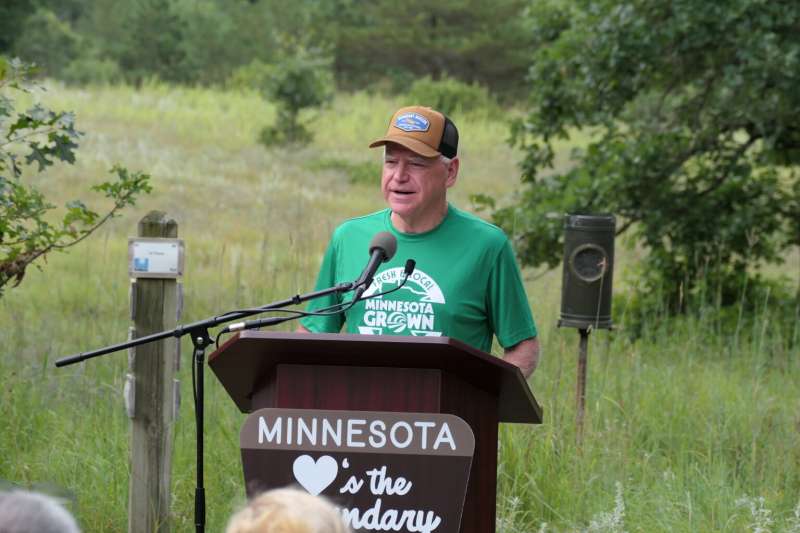
“The verdict is in. The decision’s been made. We will protect this place forever,” Walz said at a news conference on Tuesday at the Belwin Conservancy near Afton State Park, against the backdrop of rolling restored prairie and oak savanna.
In the twilight of his political career, the executive order cements Walz’s legacy as an important conservationist and serves as a capstone to his environmental agenda after two terms as governor.
Walz has overseen a raft of environmental achievements, made possible by Democrats taking control of the Legislature in 2023: mandating 100% carbon-free electricity by 2040; banning so-called forever chemicals per- and polyfluoroalkyl substances (PFAS); pushing car dealerships to sell more electric vehicles; and acquiring more than 36,000 acres for permanent protection.
He hasn’t always been in lock-step with environmentalists, however. He resisted banning mining near the Boundary Waters for years and didn’t intervene to stop Enbridge from building a massive Line 3 pipeline replacement that can carry 760,000 barrels of oil per day from the oil sands of Alberta, Canada to Superior Wisconsin.
Walz’s executive order, if it stands, would likely kill a proposed project from Twin Metals — a subsidiary of the Chilean mining conglomerate Antofagasta — which wants to extract copper, nickel, cobalt and other valuable metals from underground veins near Ely and Babbitt, about a dozen miles from the wilderness area.
It bars the Department of Natural Resources and the Minnesota Pollution Control Agency undertaking any environmental reviews or permitting any work associated with nonferrous — or non-iron ore — mining in the Rainy River Headwaters Watershed.
State permits are required for all mining projects in Minnesota, even on federal lands, meaning the ban aims to be impervious to the Trump administration’s attempts to fast-track mining in the area.
It also bars the DNR from offering any new state nonferrous mineral leases in the watershed and from formally partnering with the federal government on review of any proposals.
Walz’s order comes at a critical time: one of Twin Metals’ state leases can be terminated this year if the company hasn’t met all of the terms. Among the terms is that the lease holder would be extracting a minimum amount of minerals from the lands, but mining has not yet begun.
The move bears a strong risk of litigation from mining interests which stand to lose billions of dollars. MiningMinnesota, which serves as the lobbying and public relations arm for the mining industry, said in a statement Walz’s order “lacks legal standing and precedence.”
“Walz’s executive order is a political decision dressed up as an environmental one,” Julie Lucas, the group’s executive director, said in a statement.
The mining industry and the building trades unions argue new mining would reduce Northeast Minnesota’s economic dependence on volatile global markets for iron and steel. Its rich deposits of higher-value metals, along with gases like helium and possibly hydrogen, could offer a lifeline.
The Twin Metals proposal has featured one of the most intense, oscillating environmental conflicts in recent state history, extending all the way to Washington and back.
Earlier this year, U.S. Rep. Pete Stauber, a Republican who represents the 8th District, which includes the protected wilderness, shepherded a bill through Congress to end President Joe Biden’s 20-year federal moratorium on mining leases across more than 225,000 acres of Superior National Forest near the BWCA, which was visited by nearly 150,000 people in 2024.
Stauber is likely to lead the charge against Walz’s prohibition, and mining interests have strong allies in the White House, which is also sure to engage. Stauber called Walz’s order “radical,” saying it will cost union jobs and jeopardize school funding.
“The governor’s executive order is an outright war on Northern Minnesota and our way of life,” Stauber said in a statement.
Few places occupy such a central place in Minnesota’s collective imagination as the Boundary Waters, which has fueled a growing tourism industry that will exceed the economic benefits of mining by some estimates.
Walz spoke personally about his close connection to the place he first visited with his wife 30 years ago after moving to Mankato for a teaching job. He bought a used canoe from the storied Piragis outfitters in Ely and took students on trips into the wilderness. Later, his brother died on a 2016 camping trip there when a storm came through and felled towering pines.
“This perfect place exists because of God’s plan and the decisions of mortals to protect it,” Walz said. “Each generation has done its part, knowing that although these waters feel eternal when you’re there, they are not invulnerable. Once the majesty of the Boundary Waters is gone, no corporation, no government, and no act of God will bring it back.”
The order forces the issue of mining into the gubernatorial campaign, since the next governor will decide whether to continue the prohibition or change course.
No Democrat is likely to reverse it given the broad opposition to mining there, though DFL candidate Sen. Amy Klobuchar did not immediately comment on the order or her plans if elected.
Republicans candidate Rep. Lisa Demuth blasted Walz for his “hostility” toward mining and costing good-paying jobs.
“As governor, I will work each day to ensure mining is part of Minnesota’s future. We can do it safely here better than anywhere in the world, protecting our beloved outdoors while benefiting from the job creation and tax revenue these projects bring to northern Minnesota,” Demuth said in a statement.
Rep. Alex Falconer, a Democrat from Eden Prairie who works for the group suing to stop the Twin Metals project, Northeastern Minnesotans for Wilderness, was less optimistic than Walz that this order definitively ends the battle over copper-nickel mining.
“Antofagasta is a billion dollar international company … they can sit on a project until favorable political winds prevail,” he said. “The fight ahead of us is legislation.”
Walz’s order directs his staff to draft legislative language prohibiting mining in the Rainy River Headwaters Watershed, which would require Democrats to take back control of the Legislature by a significant margin, given that some northern Minnesota Democrats support mining in the area
State Sen. Grant Hauschild, a northern Minnesota Democrat who is in a tough reelection battle, released a statement opposing Walz’s order, for instance saying he’d pursue “an objective, science-based process.”
Bois Forte Band of Ojibwe Chairman Carlos Hernandez commended Walz at Tuesday’s news conference for helping uphold the government’s treaty obligations to protect their traditional homelands for hunting, fishing and gathering from the threat of mining pollution.
“We have heard promises that copper-nickel mining can be done safely, but when we’re talking about water that our people have depended on for generations, we cannot afford to find out after the fact that those promises were wrong,” Hernandez said.
Minnesota Reformer is part of States Newsroom, a nonprofit news network supported by grants and a coalition of donors as a 501c(3) public charity. Minnesota Reformer maintains editorial independence. Contact Editor J. Patrick Coolican for questions: info@minnesotareformer.com.