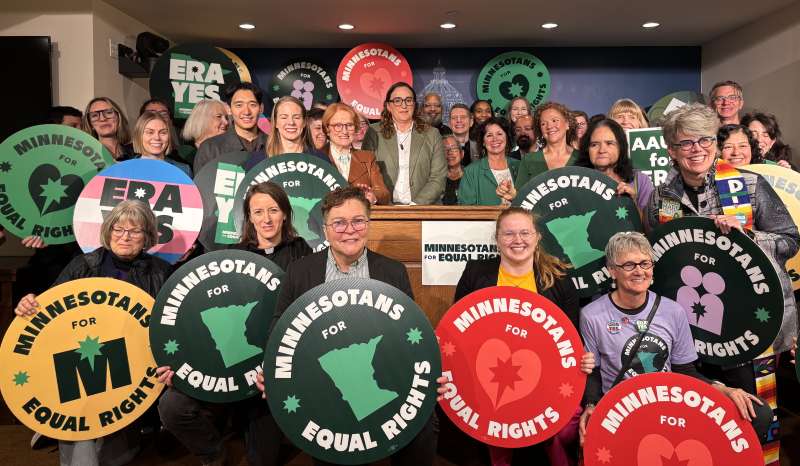
Minnesotans for Equal Rights, a movement to pass an Equal Rights Amendment (ERA) in Minnesota that would protect more of the state’s residents under the law, announced on Thursday, Nov. 12, the ERA is back on the table for the next legislative session.
The group held a press conference with chief authors in the state House and Senate, DFL Rep. Leigh Finke and DFL Sen. Mary Kunesh, and 35 other organizations like Gender Justice, ACLU of Minnesota, Voices for Racial Justice, and Pro-Choice Minnesota.
This isn’t the first time an ERA has been proposed in Minnesota, and this version includes even more identities than in the past. With the power of a new poll reporting that 67% of Minnesotans would support an ERA behind them, and a DFL trifecta once again, the legislators believe 2027 is the year Minnesota passes an ERA in the state legislature.
“We have to make sure that we are protecting every person who is in Minnesota, no matter who you are or where you come from or how you got there.”
-Rep. Leigh Finke, DFL, House chief author of the ERA
The 2024 ERA bill that did not make it onto the 2026 ballot
In 2024, during the last DFL trifecta, a Minnesota ERA almost passed both chambers of the state legislature, which would have put it on the 2026 midterm elections ballot. The amendment passed the House 68-62. It stalled in the Senate and did not come to a vote during that session, despite the Senate passing its own version in 2023, 43-23.
Republicans criticized the language of the amendment, saying it wasn’t transparent about abortion and didn’t protect Minnesotans equally, just those mentioned in the amendment.
Both chambers must agree on the amendment’s language in the same biennium and pass it through a vote before it can make it onto voter’s ballots. If this new version of the ERA passes the 2027 Legislature, it would then be available on the 2028 election ballot for voters to decide on. The amendment would need majority approval by voters, and anyone who doesn’t vote on it at all would be giving a “no” vote.
What was added to the 2027 version of the ERA
In the group’s press release, they say the new amendment would “protect Minnesotans from discrimination based on race, color, national origin, ancestry, disability, and sex, including pregnancy, gender identity, gender expression, and sexual orientation.” Kunesh said “the language is stronger,” when asked what was changed in this version of the amendment.
“The protections around pregnancy and pregnancy outcomes were not in there. Also gender identification and sexual orientation. The old ERA statement, it was basically women’s rights.”
-Sen. Mary Kunesh, DFL, Senate chief author of the ERA
Finke backed Kunesh up, saying they passed “a great bill in ‘23,” but they’ve “made the ERA better.” She noted the larger majority Democrats have in the House this time, now holding 20 votes more than the GOP, and the poll in their favor as indicators that the timing is right to advance the ERA. “All we are trying to do is get it to the people, let the people decide,” Finke explained.
The two most-asked-about additions to the amendment concern gender and pregnancy outcomes, its authors shared.
Kunesh said the language of “pregnancy outcomes” was specifically added “very clearly to include abortion as well as other reproductive healthcare.”
As for gender, Finke, Minnesota’s first openly transgender legislator, addressed questions at the Nov. 12 press conference, stating it’s “the center of everything I do.” “I would love to be in a place where the Republican obsession with transgender identity got shellacked in the elections…But we still live in the same universe that we were in last week.”
Finke says she “expects some dog fighting” in the legislature once again, regarding protections in the proposed ERA for transgender, nonbinary, and two-spirit Minnesotans, but that she will continue to fight for conversations about values over attacking others. “We’ll fight it off and we’ll pass it,” she said.
Another topic mentioned at the press conference, though not specifically addressed in the amendment, was immigration status. The proposed ERA would protect people based on ancestry and national origin, but does not explicitly address immigration status.
Jess Braverman, legal director at Gender Justice, a legal and policy advocacy organization for gender equality through legislation, said the provisions and language in the ERA would still ensure Minnesotans aren’t discriminated against based on what country they immigrate from. “So the government can’t decide we’re gonna treat certain immigrants better than others, or we’re gonna treat certain immigrants worse than others,” she said.
No committed support from Klobuchar
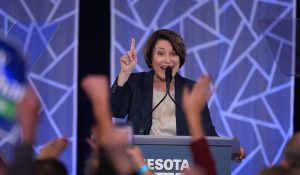
Although the amendment does not need support from the governor, who will be DFL US Sen. Amy Klobuchar beginning Jan. 4, that support would be welcomed by its proponents.
Kunesh said she spoke with Klobuchar during the election cycle and said Klobuchar came with good questions. She said the senator did not give a commitment of support, but “in the past she has supported this.”
Finke stepped in to say that even though the governor’s signature isn’t required to get this on the ballot, they “need” Klobuchar’s support as governor to get Minnesota voters onboard. She says she’s “confident” that Klobuchar will “be with us.”
Finke continued, saying that the House and Senate DFL caucuses are both supporting this amendment and that it’s a top priority. “But so is affordability, and so is fraud, and so is ICE response, and so is healthcare,” she continued. Finke ended her speech by saying that Democrats have a big list of bills they want to pass, and that the sequencing will be “less important than the fact that we are passing bills.”