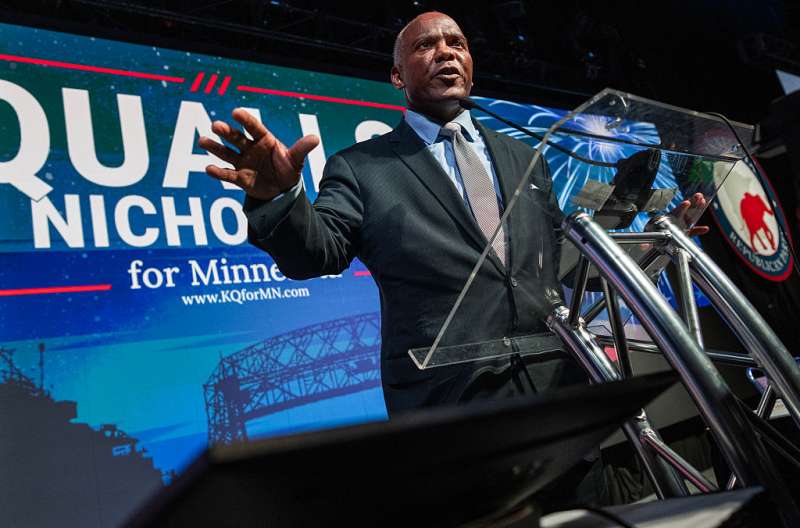
For families already doing the math at the kitchen table every month, “cutting waste” in state government can sound like good news. In Minnesota’s gubernatorial race, Republican Kendall Qualls says that’s exactly what he wants to do: go after fraud, trim the budget, and ease what he calls the “heavy yoke” of high costs.
But as Qualls campaigns on “pocketbook issues,” a growing trail of documents, interviews, and social posts raises questions about who would actually feel those cuts—and how he’s handling money and power inside his own political operation. Critics say he’s talking about billions of dollars in reductions without naming which programs families could lose access to, even as public evidence suggests his campaign may be benefiting from donor-funded nonprofit resources that are supposed to sit outside electoral politics.
Qualls touts plans to address rising costs, crime
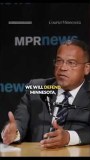
Qualls, a retired healthcare executive and frequent conservative commentator, secured the Republican Party’s endorsement for governor after a spring Republican Convention. In a follow-up interview with Minnesota Public Radio News, he said economic questions would be his “number one” focus if elected, nodding to the idea that “the economy is stupid.” He told host Clay Masters he wants to lower personal and business taxes, reduce back regulations and permitting, and crack down on what he described as a “huge unaccountable fraud problem” in the state government.
“The pocketbook issues of everyday Minnesotans is the number one issue,” Qualls said.
He has framed his run as a response to rising costs, crime, and what he sees as mismanagement at the Capitol, and had said he’d be “all in” if President Trump decided to endorse his campaign. Trump has instead endorsed MyPillow CEO and Republican candidate Mike Lindell for governor.
Qualls has since put much more specific numbers behind that message. In a July 9 report, MPR News referenced his promise of a $9 billion “fraud rebate” and said he would pay for it with broad spending cuts and other savings, including what he described as a “12% budget decrease across the board.”
To supporters, that may come off as a promise to clean house, but to his opponents, it seems like déjà vu In a June statement, the progressive group Alliance for a Better Minnesota said Qualls used his MPR appearance to tout plans to “cut billions of dollars from programs that Minnesotans rely on and slash funding for essential services,” without clarifying which line items he would touch. The group linked his rhetoric to Trump-era budget proposals such as H.R.1, which cut healthcare and food assistance while delivering major tax breaks to corporations and the ultra-wealthy.
“Minnesotans deserve to know: What programs is Qualls planning to cut, and how will this affect our families?” said Marissa Luna, executive director at ABM, in a press release.
Minnesota’s current two-year budget is about $66 billion. So far, neither Qualls’ interviews nor his public comments have spelled out which specific state programs—Medical Assistance, housing assistance, childcare subsidies, or others—would be reduced under his plan. Instead he has stayed at the level of broad categories like “fraud” and “waste,” and believes that his cuts could be managed with “little to no impact.”
The nonprofit behind Qualls’ campaign
There’s also the question of how Qualls handles money when he’s already the one in charge.
Alongside his political work, Qualls leads Take Charge Minnesota, a 501(c)(3) nonprofit that promotes conservative social and economic ideas and produces documentary projects. After a fire damaged its office building in 2024, Take Charge moved into a new Minnetonka workspace that shares a building with the conservative think tank Center of the American Experiment.
Since that move, a compilation of records shows Qualls appearing in what appears to be the same office across a variety of roles.
That overlap matters because of how the law treats charities. Under federal rules, 501(c)(3) organizations are prohibited from directly or indirectly participating in political campaigns or intervening on behalf of or against any candidate for public office. They are not allowed to give a campaign something of value without proper compensation; that includes staff time, equipment, or office space.
Minnesota campaign-finance guidance similarly warns that when a candidate’s committee uses office space provided by a corporation, it must pay “an amount equal to the fair market value” to avoid the space counting as an illegal contribution.
In some YouTube videos, social posts, and interviews, he is introduced as the founder and president of Take Charge, speaking about the nonprofit’s missions and projects, with a Take Charge sign visible in the background. In others, including TV and social media clips, he is clearly identified as a candidate for governor, delivering campaign messages or reacting to political news from what appears to be the same office space.
WATCH: Quall’s economic promises amid scrutiny over own campaign finances
Earlier footage from his 2020 and 2022 campaigns shows different backdrops, suggesting the Minnetonka office is tied to Take Charge’s current lease rather than his past political runs. The through-line is that since 2024, nonprofit and campaign content alike appear to originate from the same donor-funded office.
Who is paying Kendall Qualls?
A post on X from Republican state Rep. Elliott Engen (36A) raised further questions about how tightly Qualls’ personal finances are intertwined with his nonprofit. The post accused Qualls of benefitting from “one large donor” who supplemented Take Charge with millions of dollars, “pocket[ing] $300k annually yourself,” and using a “legal workaround to collect a salary for campaigning.”
Additional media attached to the post show lines for officer compensation and total expenses, and underline the fact that Qualls’ day-to-day income and work life run through a tax-exempt organization, even as he seeks the power to reshape the state budget.
For Minnesotans who rely on public programs—whether that’s a parent whose child’s healthcare is tied to Medical Assistance, a senior stretching grocery money with SNAP, or a worker who spends on state services during a rough patch—those struggles are significant. If Qualls wins and follows through on “billions” in cuts, the question is not just whether the state government will be smaller—it’s whose support will get smaller first.
WATCH: GOP Candidate for Governor says it’s “not an issue” that his running mate attended the Jan. 6 riots