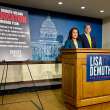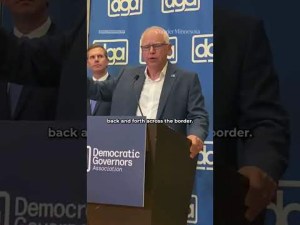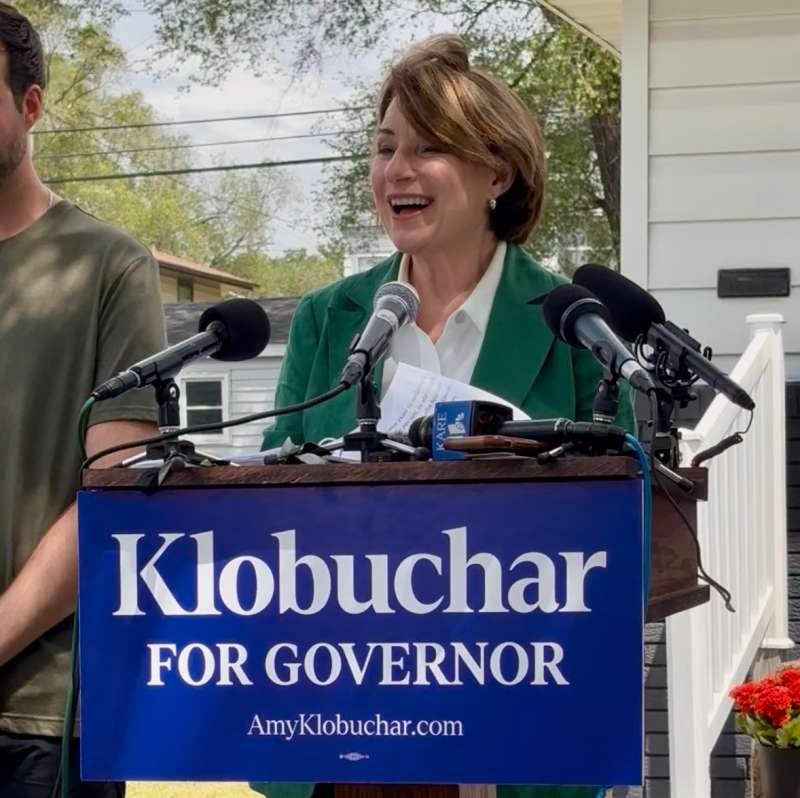
Senator Amy Klobuchar, the DFL-endorsed candidate for Minnesota’s next governor, announced five new policy proposals Monday with the aim of lowering housing costs for Minnesotans. She pledged bipartisan efforts at both the state and federal levels, referencing bills that have passed or are halfway to the finish line.
Build more homes, faster
Before revealing her priorities, Klobuchar quoted Up for Growth, a national nonprofit reporting on housing supply and affordability, which estimates that Minnesota needs about 100,000 more homes. She says she’s “committed to filling that gap” by building that number in houses, condos, and apartments.
Klobuchar mentioned reforms government oversight required to make housing accessible, such as standardization of housing permit applications to reduce redundant paperwork, consistent permit deadlines, and removing city mandates and requirements to raise construction costs.
She also wants to make it easier for cities to refurbish state land, and reward them for doing so. Klobuchar advocates that surplus land and vacant office sites be used for new housing projects instead of taking park lands. She also wants to create a Minnesota Pro-Housing Incentive to reward cities that help renovate old buildings into new housing, but didn’t say what those rewards would be or how they would be distributed.
The State Housing Tax Credit was brought up as well, as Klobuchar wants to make this permanent to “incentivize private investment in housing and rental buildings.” The tax credit provides housing loans for eligible projects. Klobuchar says the funding will come from the ROAD to Housing Act, a federal bill that has so far passed the US Senate in an 89-10 vote.
More housing in rural communities
Rural communities in Minnesota need more homes if they want to expand, and Klobuchar says big employers in Greater Minnesota are struggling to house their employees thanks to “high infrastructure costs, aging housing stock, and limited access to assistance.”
In Klobuchar’s mission to bring new ideas to the state, she says she wants to launch a Rural Housing Loan Fund, a “low-interest resolving pool to help rural developers cover the high costs,” which she again pointed to the ROAD to Housing Act as funding. She also wants to make factory-built start homes an affordable staple in rural areas. “ Housing across our state, in rural and in the metro, can’t be one size fits all. We need to support all forms of housing to really make a difference,” she says.
Make owning a manufactured home more affordable
Claiming to have met with “some of the 180,000 Minnesotans living in manufactured homes,” Klobuchar says families in trailer homes face a distinct problem, “they might own their home, but they rent the land beneath it.” This means they’re liable to raised fees, maintenance neglect, and the land being sold, without their permission.
The Minnesota Legislature tried to pass a Manufactured Home Bill of Rights this year, which would have helped with capping rent increases and utility fees, and give residents the first chance to purchase the land if it’s being sold, but it stalled in the tied House.
Klobuchar wants to go along the bill of right’s guidelines by giving residents that first chance to buy, and protect them from deceptive, hidden charges. “ As one resident explained to me, moving one of these homes can cost anywhere from $10,000 to $20,000. This leaves families stuck when their lot fees are jacked up from, say, $245 to $700 a month.” Klobuchar explained.
Support renters and stop rip-offs
Predatory pricing is an issue Minnesota renters have already faced. RealPage and six other corporate landlords were sued by Minnesota and eight other states for using algorithms to fix rent prices, which is illegal. In 2025, the states won the lawsuit and Minnesota was ultimately paid about $483,000.
Klobuchar says people need to understand that this can happen in-person, over the phone, or through these algorithms; “What they’re doing is feeding all of their data on rents to another company, and then that company spits out by sharing the information..and then giving them higher rents that they can charge.” For renters now, Klobuchar wants to pass laws at the state level that would ban price-fixing algorithms, similar to her Preventing Algorithmic Collusion Act, which is pending in the US Senate.
She also wants to make large institutional landlords report acquisitions and rent increases publicly, and in a way easily accessible for Minnesota residents such as a database.
Help Minnesotans buy homes and afford rent
While state rental assistance programs exist, Klobuchar says it is “too often” impossible for those who need it to access. She says renters must “navigate a patchwork of programs and forms” that require applicants to submit identical information multiple times. Klobuchar vows to make rental assistance more accessible by combining “state, local, and federal down payment assistance into a single application, and creating a no wrong door network.”
She mentioned her anti-fraud policy proposal as assurance that the state government will “guard taxpayer dollars” and hold the government accountable.