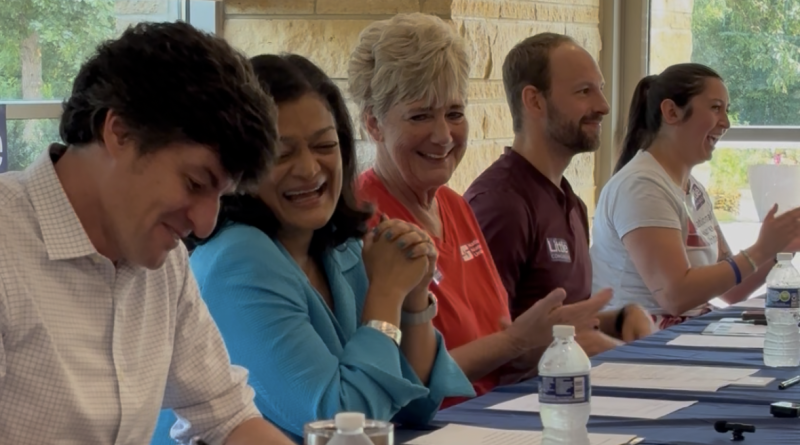
The Medicare for All Act would ensure every American has healthcare insurance, from birth to death, under a national, single-payer system. Former state Senator and the DFL-endorsed candidate for Minnesota’s 2nd Congressional District, Matt Little, held a forum in Eagan on Friday, July 24, to tell Minnesotans exactly why he’s campaigning on Medicare for All, and why it should be adopted.
Little told the crowd at the Eagan Community Center about how healthcare insurance accessibility and affordability has affected his family. “My mom’s been sick most of my life. And when my dad lost his job in the tech bubble, my mom had to cling to her job…She needed the healthcare to go to the hospital, to get the healthcare she needed from a workplace injury that she was getting at the same place she had to stay at. So I’m going to fight my ass off to make sure every single person in this country has healthcare from the day they’re born to the day they pass.”
Beside Little sat a panel of nurses, a doctor, and the author of the Medicare for All Act, US Rep. Pramila Jayapal (WA-07). Jayapal said the most important thing the bill would give Americans is freedom: “So you can think about being an artist or a musician, so you can think about changing your job because you’re not tied to the same employer… It puts us on the same level playing field as every other wealthy country in the world,” she said.
Nurses and patients need the help
The panel’s healthcare professionals included Mary Turner, the former president of the Minnesota Nurses Association and current president of National Nurses United, a union endorsing Little. Dr. Zach Shaheen from Children’s Minnesota and Rachel Andersen, a Mayo Clinic nurse of 13 years, also participated in the event.
Turner said the union is working toward “a vision for a healthy society,” which she said means a right to a union job, education, and healthcare, no matter who you are. She said more and more patients are found coming into emergency rooms because they couldn’t afford preventative care.
Turner shared the stories of two patients who came into her trauma ICU as an example of the trend. “Both had a diabetic crisis…I said, ‘Harold (false name), how come you weren’t taking your insulin?’ He said, ‘Well Mary, I couldn’t afford it.’..The next guy had insurance. He could afford insulin. But his son, who was also diabetic, couldn’t afford it. So he was giving him half of his insulin.”
Dr. Shaheen, a children’s immunologist, said that the healthcare system is “broken.” The US, he argued, actually already has universal healthcare, but it isn’t the kind people think of when they hear those words. “If you end up at the emergency department, you don’t get turned away right? We’ll move mountains to make sure you get that care. But if patients don’t have insurance, they can’t afford that emergency life-threatening care, the hospital systems, and by extension us, swallow that cost.”
Shaheen added that, in his view, Medicare for All would create a compassionate and money-saving healthcare insurance program. He said decoupling healthcare plans from employers “gives us freedom and flexibility” to choose our insurance, while keeping private healthcare systems open to innovate. “We can keep competitiveness and we can still have universal healthcare that’s financed through our government,” he said.
Andersen said the current healthcare system isn’t what she was promised when she chose to become a nurse. “I went to school because I believe in keeping families together…I did not go to school to learn how to chart for regulations that allow for increased reimbursements,” she said.
Andersen said there are no staffing requirements for Minnesota hospitals, so patients face long waits while waiting for treatment in the ER. She said it isn’t a secret that hospitals are low-staffed, but claimed that administrators aren’t doing anything about it. “Healthcare is essential. It is mandatory for having a compatible life…I have not met a single person that doesn’t require healthcare.”
Answering to the community
Attendees of the event asked the panel a few questions related to the bill. One man brought up the recent US House vote to cut off $3.3 billion in aid to Israel. He asked what the chances were the bill could be brought to a vote again, and if that money could instead be redirected to Medicaid funding.
Little said all budget money can be moved around and said he would “be very on board with that.” He added that “when” he gets into Congress, he wouldn’t just vote for the amendment, but author it. “We need to stop military aid to Israel. We need to pass a weapons embargo.”
Jayapal said she voted for US Rep. Thomas Massie’s (R-KY) amendment to the bill, and that 104 other members did as well. “That’s the most we’ve ever seen,” she pointed out. She echoed Little on ending aid to Israel, noting that “we need to stop taking taxpayer dollars and putting it into bombs that kill children in Gaza.”
Jayapal also brought up the fact that Republicans passed a $1.15 trillion budget for the Pentagon this week, which adds another $70 billion to the Iran war fund. She called it ‘illegal and unconstitutional,” arguing that America’s money is being put toward the wrong things. “We have the money to do the things we wanna do and should do and are necessary, but we choose to put it into things that are not benefiting the American people,” Jayapal said.
A woman asked the two if it’s possible to get pharmaceutical drug advertisements off TV. Jayapal said she’s already on it, and proud to sponsor the End Prescription Drugs Ads Now Act. She called it a waste of money. Little said when he was in the Minnesota Senate, he was the “only author of the legislation to ban pharmaceutical ads on TV, and they started spending money against me two years before my re-election.”
A nurse at Abbott Northwestern asked the two to comment on the possibility of antitrust legislation. Jayapal said the federal legislative group she’s created, the Monopoly Busters Caucus, is working on a series of bills to address monopolies and mass consolidation of hospitals and healthcare systems. Little enthusiastically agreed with the concept, asking Jayapal, “Can you sign up before you’re elected?”