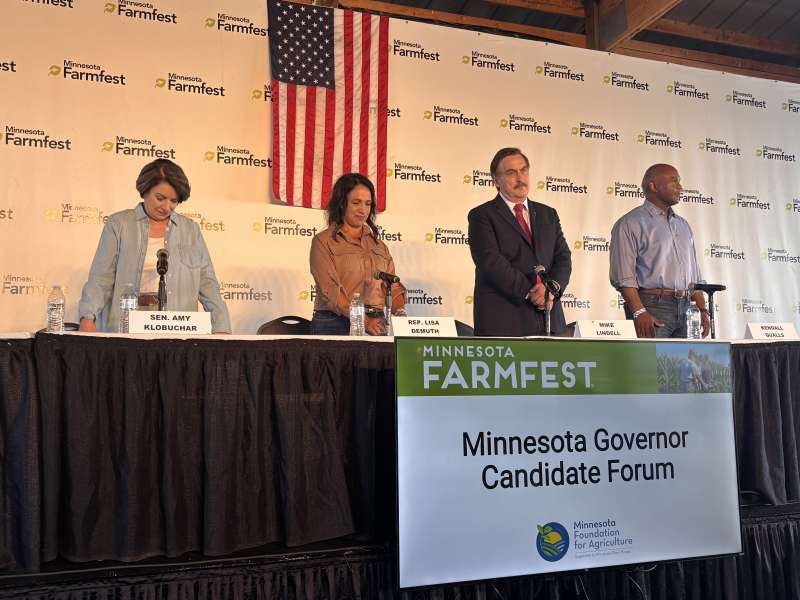
After attending a series of political candidate forums at the first two days of Minnesota Farm Fest 2026 on Aug. 4-5, it was obvious that there has been a shift in the narrative for the state’s farmers. Before we get into the three key takeaways that show what may be turning for the ag industry, here’s why it matters in the first place.
What is Farm Fest and why it’s important
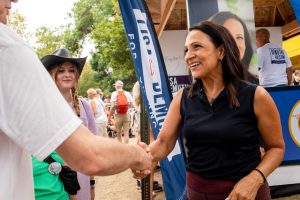
Farm Fest is the state’s annual agriculture convention, where farmers across the state meet to talk about new issues in the ag world, buy and sell machinery and technology, host educational sessions, and very importantly, question current or future lawmakers about agricultural and trade policies.
With this year being an election year, and Farm Fest taking place the week before the primary election on Aug. 11, this event was key for candidates to prove their worth to voters.
When it comes to politics in the North Star state, it gets a little muddy. Minnesota has historically been a purple state. From 1860 until 1932, it almost exclusively voted red for Republicans in key elections. From 1932 to today, Minnesota has almost exclusively voted blue for Democrats in statewide contests. The divide is illustrated by hyper-blue cities, the purple suburbs, and the mainly red rural land that covers most of Minnesota.
While the Twin Cities of Minneapolis and St. Paul are by far the most progressive and densely blue, the other larger cities in Minnesota, like Rochester and Duluth, are as well. Over half of the state lives in these cities and the seven-county metro district.
The other 45% of Minnesota residents live in what’s known as Greater Minnesota, the vast rural, mostly farmland landscape that makes up everywhere in between the aforementioned metro district. This ranges from lightly red in southeast Minnesota, to deep red in central and northwest Minnesota.
Most candidates for the state stay cozied up to their regular crowd: DFL and progressive leaders to voters in the cities, GOP and MAGA leaders to those in the deep red communities scattered across Greater MN. But what happens when they all get together to talk about one of the state’s biggest economic drivers: agriculture? That’s where you get Farm Fest.
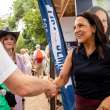
DFL and GOP candidates for multiple electoral races came to speak in different forums, each with large crowds of supporters, opposers, and undecided farmers interested in hearing what they had to say on the issues they care about. The event featured candidate forums for congressional districts 1, 2, 6, 7, and 8, and forums for the governor and US Senate races.
Each forum lasted about an hour, with candidates being asked between 11 and 14 questions each. They were each given one minute to answer each question, and two minutes to give closing comments. Despite being in Morgan, Minnesota, a fairly red part of the state, covered in cornfields and with a population of only 888 people, the crowd gave some interesting responses to the separate parties.
Here’s what stood out:
The rise and fall of the DFL Party for farmers
Minnesota is the only state to use DFL as its affiliate for the US Democratic Party. The acronym is simple, D for democratic, F for farmer, and L for labor. The party was created in 1944 when the weaker Democratic Party and the stronger Farmer-Labor Party merged to become one. The DFL says Former US Senator for Minnesota and US Vice President Hubert H. Humphrey was “instrumental in the merger” and he is thought to be “the founder of the MN DFL Party.”
The DFL saw success after the merger and led party candidates to multiple wins throughout the years. The last two governors of the state, incumbent Tim Walz and Mark Dayton, led the DFL campaign in office from 2011 until now.
But, since the rise of President Donald Trump in 2016, farmers have shifted away from the very party that has their namesake. Many farmers believe that the DFL “hasn’t represented farmers in generations,” instead focusing on progressive and labor campaigns.
In the congressional districts spreading across almost all of Minnesota’s farmland, like districts 1, 6, 7, and 8, the US Representatives are all Republicans. Brad Finstad (CD-1) has been in office since 2022, Tom Emmer (CD-6) since 2015, Michelle Fischbach (CD-7) since 2021, and Pete Stauber (CD-8) since 2019.
3 key takeaways from Farm Fest 2026
Each candidate forum had a different energy, whether it was the crowd, the contenders, the moderator, or the weather, but almost all of them had something in common: the DFL candidates were better received than what some might have guessed.
DFL candidates were actually being cheered for, not just booed at
While yes, some DFL candidates were booed at when it came to immigration reform or fraud, they were also cheered for on a number of other issues central to the ag industry and rural communities
This included Jake Johnson for CD-1 talking about rural healthcare cuts, Erik Osberg for CD-7 calling out “dysfunction” in the USDA, and Trina Swanson demanding we crack down on Republican state fraud too. Doug Chapin for CD-6 was widely applauded for calling out US Rep. Tom Emmer for being a no-show, while Matt Little and Kaela Berg for CD-2 both gave well-received answers to questions on farming infrastructure and mental health access.
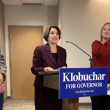
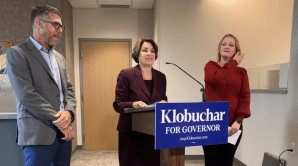
US Rep. and US Senate candidate Angie Craig had about half of the crowd cheering for her every answer, while her opponent Lt. Gov. Peggy Flanagan made some headway on revoking data centers from using farmland. US Sen. and governor candidate Amy Klobuchar gave rousing closing comments.
GOP candidates were booed…a lot
The GOP candidates were not as universally received at many of the conversations held at Farm Fest. The crowd offered meek applause to many answers from Republican incumbent Brad Finstad (CD-1) and GOP contender for CD-2 Eric Pratt.
Michelle Fischbach (CD-7) was straight up booed for blaming the Biden administration for making “zero trade deals,” having to ask for more time to answer her question as the crowd went wild. And Pete Stauber (CD-8) didn’t do much better, getting heckled for defending Emmer for not showing up, saying he was “fighting for his damn life.” This wasn’t true, as Emmer was on FOX the previous morning, and had actually just injured his foot, requiring surgery.
The crowd was ready for change
The crowd was rowdy throughout each forum. No matter which candidates were up, no matter how many times moderators had to ask the crowd to be respectful and silent, and no matter the fact that Farm Fest has always been respectful to political candidates in years before, farmers largely seemed fed up with the status quo.
The crowd cheered, booed, yelled in the middle of answers, and even verbally fought with each other behind where the press was seated. And sometimes they had good reason. Royce White, a GOP candidate for US Senate, shamed the DFL part of the crowd repeatedly during his forum answers, calling them “commie-crats.” Some candidates also got booed for avoiding clear answers to questions, like how GOP governor candidate Kendall Qualls kept answering that Minnesota “needs to see a radical change,” without offering much detail on how he would achieve that.
Another reason farmers were rowdy? They’re clearly frustrated with how things are going. Fertilizer prices are up 40% for some farmers. Gas is up to $4 a gallon in some districts, not to mention diesel prices are near $5.60 a gallon. Tariffs have created higher input costs for machinery and repair parts. And the Trump administration has pulled significant funding from the USDA–and therefore, farmers–when it comes to supportive resources and programs.
While the majority of farmers voted this administration into office, Farm Fest demonstrated that the winds could be changing course this year.