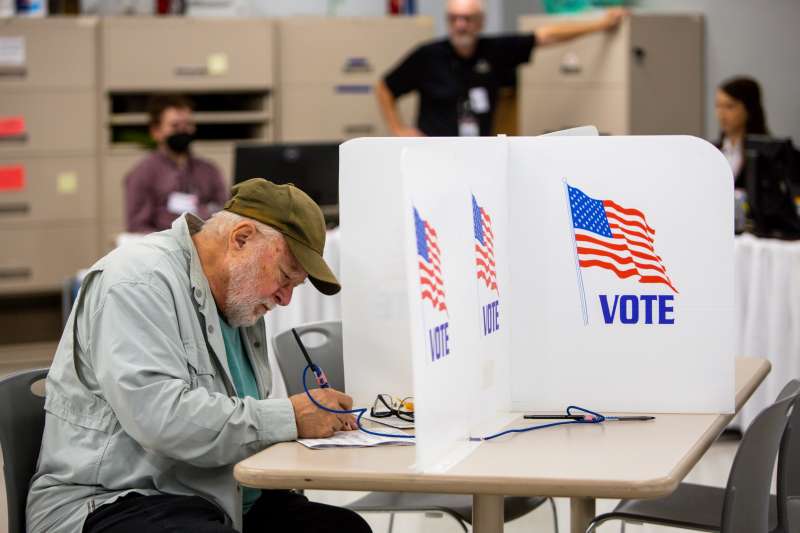
When voters in Minnesota’s 2nd Congressional District head to the polls for the August primary, leaders in the state and beyond will closely monitor results. In a district encompassing an even split of city dwellers, suburbs, and rural farmland, many believe this corner of the state acts as a bellwether for the rest of Minnesota.
Muneeb Ahmed, director of the Muslim American Society Lakeville Masjid and a leader with ISAIAH, a nonpartisan nonprofit focused on engaging underrepresented communities in civic life, lives in the district and sees it playing an outsized role in November.
“This district will determine which issues and messages make an impact beyond the Twin Cities metro,” Ahmed said. “The diversity that this area has means that neither party can afford to take voters for granted. As a result, campaigns are forced to engage with real concerns and engage voters instead of relying on talking points.”
MN-02 is also the only open congressional race in Minnesota this year after Congresswoman Angie Craig announced last August that instead of running for reelection, she’d be launching a campaign for US Senate.
“The 2nd Congressional District is the swingiest of the Minnesota districts, for sure,” said Dr. Ryan Dawkins, an assistant professor of political science at Carleton College in Northfield. “It encompasses the Twin City suburbs and comes all the way down into rural areas.”
MN-02 has vacillated over the years between electing Republicans and Democrats in both presidential and state races. This district chose Joe Biden in 2020 and Kamala Harris in 2024, even after President Donald Trump won the district in 2016.
Dawkins pointed out that Northfield, where his college is based, is “quite progressive.” Former President Joe Biden even unveiled his rural initiative in Northfield in 2023.
“It’s a rural area, but it’s also fairly friendly as things go for Democrats,” Dawkins said.
Democratic hold appears steady ahead of midterms
Craig has held the seat in this district since she beat Republican Jason Lewis in 2018 after losing to him in the 2016 election by just under 7,000 votes. Their 2016 matchup was watched with interest since the seat had been long held by retiring Republican Rep. John Kline.
The Cook Political Report predicts another Democratic win for the District 2 seat, rating it at +3 for a Democratic candidate. The Democratic-Farmer-Labor Party has endorsed Matt Little for the position. Little, a Lakeville native, leads the field in fundraising with more than $716K raised, but Democrat Matthew Kline is close behind at $699K, signaling a competitive primary despite the endorsement.
Dawkins doesn’t believe a Republican can make headway in the district this year, but he said Kistner—ho dropped out in April after being called up for active duty as a marine—would have been the most competitive option.
ICE raids, affordability among key issues for voters
The midterms will mark the first time Minnesotans have taken to the polls in the wake of ICE raids on the Twin Cities in December 2025. Polling conducted by Emerson College in February showed voters were mostly disapproving of the government’s handling of those raids as they pertained to the deaths of Alex Pretti and Renée Good.
That disapproval was largely partisan, with 94% of Democrats and 64% of Republicans saying they disapproved of the administration’s handling of the incidents.
Exit polling in the district conducted after the 2024 elections showed voters were most concerned about issues of immigration, abortion, the economy, and election integrity.
Emily’s List, a Democratic organization that works to get women elected to office, quickly endorsed Berg when she announced her bid for the seat given her stance as a parent and pro-choice advocate.
When it comes to the issues of affordability, Republicans and Democrats in the state agree it’s an issue for most voters—but they disagree on how to combat it. Democrats favor bills outlawing grocery price-gouging and late fees for utilities, instead proposing increases for childcare tax credits. Republicans look toward tax cuts, including $1 billion in property tax cuts, arguing that government costs and inflation are the main culprits.
Dawkins said affordability and Operation Metro Surge will be top of mind this year as voters head to the polls. And he believes farmers in the district, who have “fared uniquely poorly” under the Trump administration, will play a pivotal role.